
Operational Conversational Intelligence

Turning Customer Calls Into Structured Business Action

A practical guide to capturing meaningful information from AI phone conversations and using it to initiate operational workflows, improve customer follow-through, and create highly relevant marketing audiences.

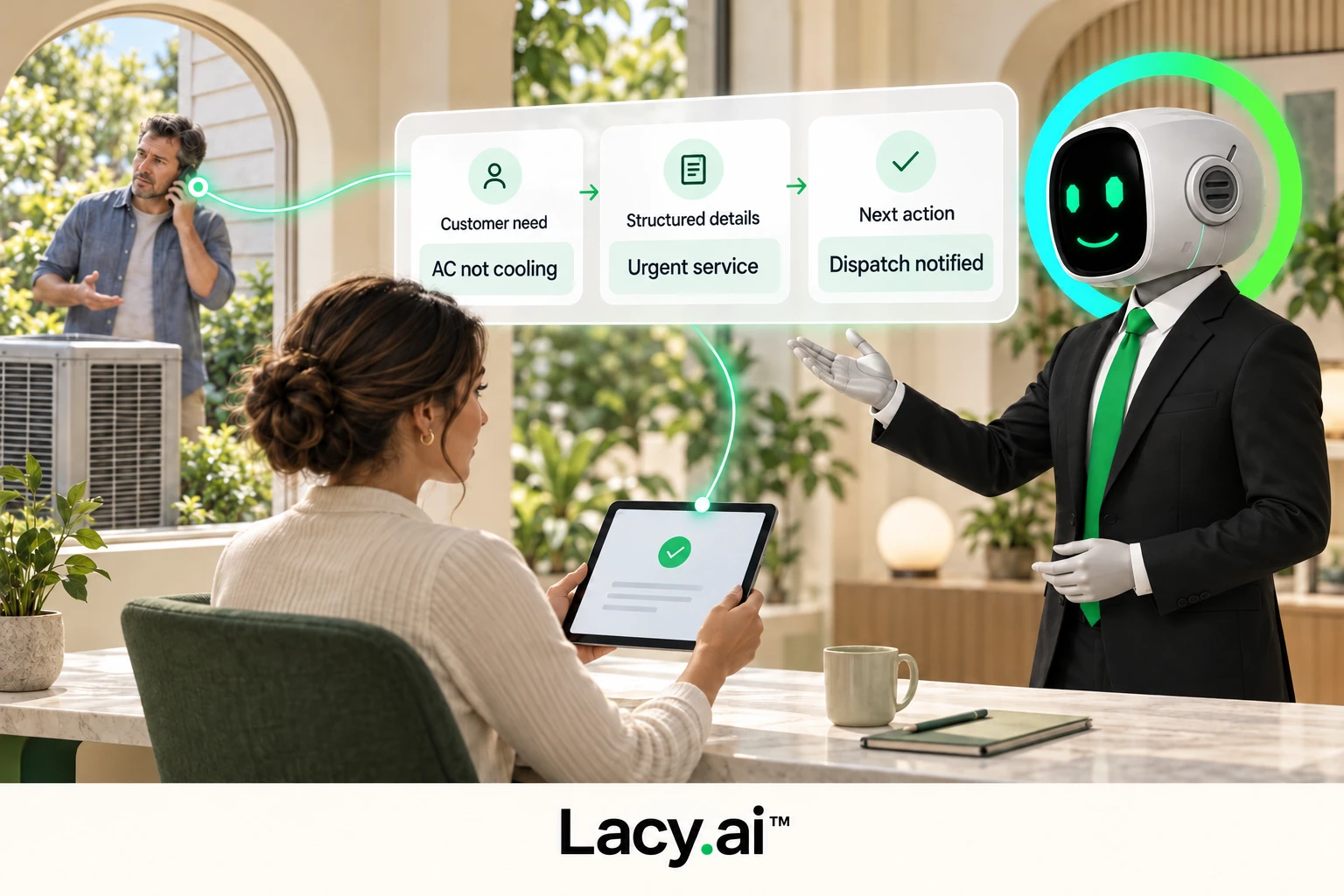
Illustrative HVAC call becomes structured urgent-service details and a dispatch notification
Customer need → Structured details → Next action
Lacy.ai TM
How to Use This Guide

A working tool for planning post-call intelligence.

Use this guide to identify the information your business needs from each call, connect that information to a defined operational purpose, and determine which system, department, or automation should receive it. Begin with the highest-value call types and expand the framework as real conversations reveal new requirements.

Guiding Principle

Do not capture a data point simply because it is available. Capture it because it improves a decision, powers a workflow, strengthens customer service, or creates a measurable business outcome.

This resource is designed for Home Services and B2B Service companies evaluating which post-call data should be captured, where that information should be stored, and what each data point should enable downstream.

How the Intelligence Layer Works

One conversation. Two categories of business value.

Post-call variables convert natural customer language into structured information. That intelligence can immediately support operational execution while also placing customers into highly relevant marketing audiences based on needs expressed during the call. Learn how structured call intelligence supports service business growth.

Illustrative Call-to-Action Flow
Incoming Home Services Call
Conversation Processing

“Our air conditioner is no longer cooling. We need someone as soon as possible. The system is more than fifteen years old, and if repairing it is not worthwhile, we would consider financing a replacement.”

Service HVAC cooling
Urgency Immediate
Equipment 15+ years old
Opportunity Replacement
Commercial Financing interest
Operational Conversational Intelligence

Trigger immediate workflows

Create a high-priority HVAC service request
Notify dispatch of the urgent cooling issue
Update the customer and property records
Alert sales to the replacement opportunity
Send the appropriate appointment follow-up

Highly Segmented Marketing Intelligence

Create relevant audiences

HVAC replacement consideration
Aging equipment ownership
Financing-interested homeowners
Urgent repair-to-replacement opportunities
Educational replacement follow-up audience

Operational value

Teams receive the context required to route, schedule, prioritize, and follow through without manually interpreting the call.

Marketing value

Customers can receive educational and promotional outreach aligned with needs they voluntarily expressed during the conversation.

Reporting value

Leadership gains structured visibility into customer demand, recurring concerns, commercial opportunities, and workflow outcomes.

Data Planning Framework

Define post-call data around the work it needs to support.

The recommended framework begins with broad business categories. Each company can then define the specific fields, accepted values, and workflows appropriate for its services, customers, systems, and operating model.

Recommended Approach

Start with a focused set of reliable, high-value data points. Confirm that each field has an owner and a downstream purpose before expanding the framework.

Information category Captured information Operational use Marketing and reporting
Call intent

What It Can Capture

  • Reason for calling
  • Requested outcome
  • Customer objective

Operational Use

  • Route the request
  • Select call disposition
  • Initiate the correct process

Marketing and Reporting Use

  • Measure demand by call purpose
  • Create need-based audiences
Service or product interest

What It Can Capture

  • Service type
  • Product category
  • Project scope

Operational Use

  • Assign the correct team
  • Prepare for the next conversation
  • Identify service requirements

Marketing and Reporting Use

  • Service-specific education
  • Promotional audiences
  • Lifecycle campaigns
Urgency and timing

What It Can Capture

  • Emergency status
  • Preferred service date
  • Project timeline
  • Renewal timing
  • Purchasing window

Operational Use

  • Prioritize work
  • Escalate urgent requests
  • Schedule appropriately
  • Create time-based follow-up

Marketing and Reporting Use

  • Near-term demand
  • Seasonal demand
  • Future demand
  • Event-driven audiences
Customer and property context

What It Can Capture

  • Customer type
  • Property type
  • Location
  • Account relationship
  • Equipment
  • Environmental conditions

Operational Use

  • Improve qualification
  • Route by territory
  • Prepare technicians
  • Apply account rules

Marketing and Reporting Use

  • Geographic audiences
  • Customer categories
  • Property-based segments
  • Installed-equipment segments
Commercial context

What It Can Capture

  • Budget range
  • Financing interest
  • Proposal status
  • Contract timing
  • Purchasing process
  • Decision readiness

Operational Use

  • Prioritize opportunities
  • Select sales follow-up
  • Advance the opportunity

Marketing and Reporting Use

  • Financing audiences
  • Proposal follow-up
  • Upgrade opportunities
  • Renewal audiences
  • Consideration-stage campaigns
Customer sentiment

What It Can Capture

  • Satisfaction
  • Frustration
  • Concern
  • Hesitation
  • Cancellation risk

Operational Use

  • Escalate the call
  • Initiate service recovery
  • Request supervisor review
  • Trigger retention workflow

Marketing and Reporting Use

  • Suppress inappropriate promotions
  • Identify customer friction
  • Measure sentiment trends
Decision and stakeholder context

What It Can Capture

  • Decision-maker status
  • Additional stakeholders
  • Approval process
  • Procurement requirements
  • Next-step dependencies

Operational Use

  • Route the opportunity
  • Prepare the assigned team
  • Support the buying process

Marketing and Reporting Use

  • Account-based outreach
  • Stakeholder-specific follow-up
  • Procurement-stage education
Next-best action

What It Can Capture

  • Appointment
  • Transfer
  • Quote
  • Callback
  • Work order
  • Escalation
  • Document request

Operational Use

  • Create an owned action
  • Notify the responsible team
  • Track completion

Marketing and Reporting Use

  • Track call-to-outcome performance
  • Prevent irrelevant outreach
  • Coordinate lifecycle communication

Planning questions for each proposed data point

Use these questions as a review worksheet before approving a post-call field or connecting it to an automated workflow.

01. What customer statement or behavior produces this information?
02. Which department or system needs the resulting data?
03. What decision or workflow will the information support?
04. Should the value follow a controlled format or remain open text?
05. What should happen if the information is missing or uncertain?
06. Does the action require human review before execution?
07. How will accuracy and workflow performance be tested?
08. Who owns future changes to the definition and downstream use?
Operational Use Guide

Make every captured signal useful across the business.

Post-call intelligence becomes valuable when it reaches the people and systems responsible for the next action. The matrix below illustrates how the same conversation data can serve distinct operational purposes across multiple departments.

Department Call intelligence Workflow Business value
Sales

Useful Call Intelligence

  • Service interest
  • Project scope
  • Decision readiness
  • Timeline
  • Financing
  • Stakeholders

Potential Workflow

  • Assign opportunity
  • Create follow-up task
  • Notify representative
  • Update pipeline stage

Expected Business Value

  • Faster response
  • Stronger prioritization
  • Better-prepared conversations
Marketing

Useful Call Intelligence

  • Expressed interests
  • Customer needs
  • Equipment
  • Property type
  • Buying stage
  • Timing

Potential Workflow

  • Add to relevant audience
  • Initiate educational sequence
  • Suppress unrelated outreach

Expected Business Value

  • More relevant campaigns
  • Less generic communication
  • Improved segmentation
Operations

Useful Call Intelligence

  • Service type
  • Urgency
  • Location
  • Access details
  • Equipment
  • Special requirements

Potential Workflow

  • Create work order
  • Route by territory
  • Notify dispatch
  • Add fulfillment instructions

Expected Business Value

  • Fewer incomplete handoffs
  • Better service preparation
  • Faster operational response
Customer service

Useful Call Intelligence

  • Account status
  • Complaint type
  • Sentiment
  • Requested resolution
  • Escalation risk

Potential Workflow

  • Create support case
  • Notify supervisor
  • Initiate service recovery
  • Schedule callback

Expected Business Value

  • Faster resolution
  • Consistent customer care
  • Reduced cancellation risk
CRM and RevOps

Useful Call Intelligence

  • Call outcome
  • Qualification
  • Next action
  • Lead source
  • Appointment
  • Commercial context

Potential Workflow

  • Update records
  • Create activities
  • Standardize dispositions
  • Connect revenue outcomes

Expected Business Value

  • Cleaner data
  • Stronger attribution
  • Dependable reporting
Leadership

Useful Call Intelligence

  • Demand patterns
  • Recurring objections
  • Service issues
  • Conversion signals
  • Workflow outcomes

Potential Workflow

  • Populate dashboards
  • Identify trends
  • Compare locations
  • Monitor exceptions

Expected Business Value

  • Structured customer intelligence
  • Clearer operational visibility
  • Better-informed decisions
Recommended Implementation Sequence

Move from business requirements to dependable automation.

A phased process helps protect data quality and prevents unreliable extraction from triggering inappropriate downstream actions.

01

Select priority call types

Begin with conversations that have clear operational or revenue impact.

02

Define the desired action

Document what should happen after the call and which team owns the result.

03

Approve field definitions

Establish the meaning, format, accepted values, and missing-data behavior.

04

Map systems and records

Determine where each value belongs across CRM, scheduling, dispatch, and marketing tools.

05

Test representative scenarios

Validate extraction and workflow behavior across normal, incomplete, and unusual calls.

06

Measure and improve

Review real calls, exceptions, business outcomes, and opportunities for expansion.

Important Implementation Consideration

Not every data point should immediately trigger an automated action. Higher-risk events, including cancellations, complaints, financial commitments, and sensitive account changes, may require defined confidence thresholds or human review before execution.

Every Conversation, Operationalized.

Build a post-call intelligence framework around your real operations.

Lacy.ai can help identify high-value call signals, define extraction requirements, map connected systems, and configure the workflows that should follow each customer conversation.

Book a Lacy.ai Demo
Lacy.ai robot with green tie and thick halo