Compare AI Phone Agents

Lacy.ai vs. the Rest

Compare the leading AI phone agent and call automation platforms, then see why Lacy.ai is built specifically for Home Services and B2B service teams that need answered calls, qualified leads, booked appointments, and CRM-connected operational workflows.

Book a Free 30-Minute Demo
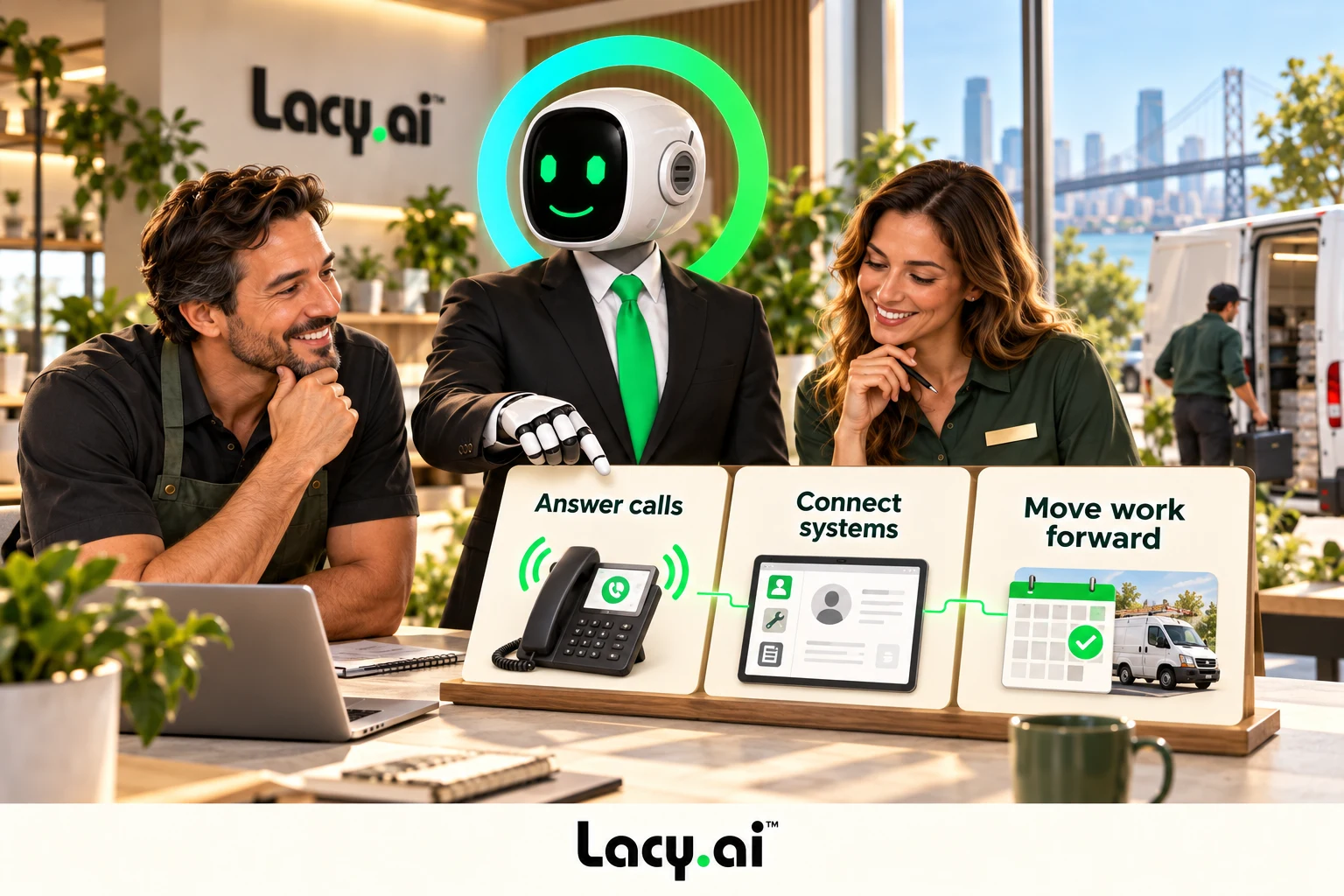
Lacy.ai and a service team evaluating call answering, connected systems and next actions

Why service businesses compare Lacy.ai

Most comparison pages lump together every voice AI tool on the market. Lacy.ai takes a narrower, more operational approach. We are focused on Home Services and B2B Services , businesses where phone calls directly affect booked work, lead conversion, scheduling efficiency, and customer experience. That means our comparison content is written around the outcomes operators actually care about: AI answering service performance, AI appointment booking, AI lead qualification, CRM call automation, inbound call automation, and end-to-end follow-up workflows.

Choose a platform to compare.

Platform comparison

Lacy.ai vs. Bland AI

Both Lacy.ai and Bland AI enter conversations around AI voice agents. The difference is positioning. Bland AI is commonly evaluated by teams looking for programmable voice infrastructure. Lacy.ai is built for service businesses that need AI phone agents connected to booking, qualification, CRM updates, and downstream operations.

Explore comparison →

Platform comparison

Lacy.ai vs. Vapi

Vapi is frequently considered by developer teams building custom voice AI products. Lacy.ai is aimed at business operators who want AI phone agents already shaped around service calls, missed call recovery, appointment booking, customer follow-up, and CRM-connected execution.

Explore comparison →

Platform comparison

Lacy.ai vs. Synthflow

Synthflow is often evaluated in the no-code AI voice automation category. Lacy.ai competes most directly when a business needs AI phone agents that do more than converse , they need to convert calls into structured operational actions across Home Services and B2B Services.

Explore comparison →

Platform comparison

Lacy.ai vs. Retell AI

Retell AI is often included in modern voice agent evaluations. Lacy.ai is the more direct choice for service businesses that want AI phone support connected to practical workflows like new lead intake, service qualification, appointment booking, and automated follow-up.

Explore comparison →

Platform comparison

Lacy.ai vs. Goodcall

Goodcall is a useful comparison when buyers are specifically searching for AI phone answering for small businesses. Lacy.ai becomes especially compelling when the need expands beyond answering to include qualification, booking, CRM updates, and ongoing workflow automation for revenue-generating service teams.

Explore comparison →

Platform comparison

Lacy.ai vs. Smith.ai

Smith.ai is a strong comparison when buyers are looking at AI receptionists, virtual receptionist services, and call answering support. Lacy.ai is the stronger fit for service businesses that want AI phone agents deeply tied to lead qualification, appointment scheduling, CRM workflows, and operational execution.

Explore comparison →

Platform comparison

Lacy.ai vs. ServiceTitan AI Voice Agent

This is one of the most important comparisons for the Home Services market. ServiceTitan AI Voice Agent is tied closely to the ServiceTitan ecosystem, while Lacy.ai is positioned as an AI phone support layer for Home Services businesses that want flexible call automation, appointment booking, lead qualification, and connected workflows.

Explore comparison →

Platform comparison

Lacy.ai vs. PolyAI

PolyAI is often viewed through the lens of enterprise voice AI and customer service automation. Lacy.ai competes best when the buyer is a service business that wants a more direct path to AI phone agents for inbound calls, scheduling, qualification, and CRM-connected customer workflows.

Explore comparison →

Platform comparison

Lacy.ai vs. Twilio

Twilio is a major communications infrastructure platform, not a direct one-to-one equivalent of Lacy.ai. The real comparison is between building with APIs versus buying a business-ready AI phone support platform for service calls, scheduling, qualification, and operational workflows.

Explore comparison →

Platform comparison

Lacy.ai vs. Five9

Five9 is typically considered in larger contact center and enterprise customer service environments. Lacy.ai is better aligned to service businesses that want a lighter, more focused AI phone support solution for handling customer calls, booking appointments, qualifying leads, and driving structured workflow outcomes.

Explore comparison →

Explore the differences.

Lacy.ai vs. Bland AI

Both Lacy.ai and Bland AI enter conversations around AI voice agents. The difference is positioning. Bland AI is commonly evaluated by teams looking for programmable voice infrastructure. Lacy.ai is built for service businesses that need AI phone agents connected to booking, qualification, CRM updates, and downstream operations.

Where Lacy.ai fits best

If your team needs more than a voice interface , and instead needs a system that can answer customer calls, capture structured job information, qualify leads, route outcomes, and support real operational workflows , Lacy.ai is the more direct fit. That is especially true for Home Services companies and B2B service organizations managing repetitive, high-value customer calls.

  • Better aligned to AI phone support for service businesses, not only voice infrastructure.
  • Focused on booked appointments, qualified leads, and cleaner front-office operations.
  • Designed for CRM-connected call automation and workflow execution after the call ends.
Best fit Home Services and B2B service teams that need operational AI phone agents
Primary use case Answer, qualify, schedule, sync
Lacy.ai focus Service-business call workflows
Why buyers compare Teams evaluating programmable voice AI vs. operational AI phone support
Operator outcome Fewer missed calls and more completed next steps
Read more about Lacy.ai vs. Bland AI →

Lacy.ai vs. Vapi

Vapi is frequently considered by developer teams building custom voice AI products. Lacy.ai is aimed at business operators who want AI phone agents already shaped around service calls, missed call recovery, appointment booking, customer follow-up, and CRM-connected execution.

What service operators should know

When the buying decision is centered on operational outcomes, the comparison changes. Instead of asking how flexible the voice infrastructure is, many buyers ask whether the platform can reliably help answer more calls, qualify more opportunities, and connect call outcomes to business systems. That is the core Lacy.ai use case.

  • A stronger fit for operators who want AI phone agents without building the whole stack.
  • Built around call automation, service request capture, and business workflow continuity.
  • Supports the operational side of voice AI: structured data, scheduling, routing, and follow-up.
Best fit Teams seeking AI phone support rather than raw developer infrastructure
Primary use case Phone-based lead capture and service coordination
Lacy.ai focus Operational voice workflows for service companies
Why buyers compare Businesses comparing custom build flexibility vs. ready-to-run workflows
Operator outcome Faster time to value for service teams
Read more about Lacy.ai vs. Vapi →

Lacy.ai vs. Synthflow

Synthflow is often evaluated in the no-code AI voice automation category. Lacy.ai competes most directly when a business needs AI phone agents that do more than converse , they need to convert calls into structured operational actions across Home Services and B2B Services.

Why this comparison matters

A no-code experience is useful, but operational depth matters more for teams that depend on calls. Lacy.ai is designed around high-intent business conversations: booking appointments, qualifying callers, capturing service request data, escalating when needed, and syncing every meaningful outcome into CRM and workflow systems.

  • Built for AI appointment booking, AI lead qualification, and inbound call automation.
  • Better aligned to businesses where the phone is still a primary growth channel.
  • Focuses on turning voice data into structured business data in real time.
Best fit Service teams that need action-oriented call workflows
Primary use case Capture, qualify, and route service calls
Lacy.ai focus Operational phone support and workflow automation
Why buyers compare Teams comparing no-code voice AI vs. business-ready service workflows
Operator outcome More useful call outcomes for operators and admins
Read more about Lacy.ai vs. Synthflow →

Lacy.ai vs. Retell AI

Retell AI is often included in modern voice agent evaluations. Lacy.ai is the more direct choice for service businesses that want AI phone support connected to practical workflows like new lead intake, service qualification, appointment booking, and automated follow-up.

Lacy.ai’s positioning in this comparison

Lacy.ai is not trying to be a generic tool for every industry. The platform has been positioned for Home Services and B2B Services where repetitive call patterns, scheduling needs, and customer routing create obvious operational leverage. That vertical focus helps shape how AI phone agents behave in real business environments.

  • Purpose-built around service-business call flows and business process continuity.
  • Helps teams manage more calls without adding front-office headcount.
  • Combines AI answering, qualification, and workflow action in one operational motion.
Best fit Businesses that need AI call handling tied to service workflows
Primary use case Front-office automation for customer calls
Lacy.ai focus Operational execution before and after the call
Why buyers compare Teams comparing modern voice agents through an operational lens
Operator outcome Stronger workflow adoption across real service teams
Read more about Lacy.ai vs. Retell AI →

Lacy.ai vs. Goodcall

Goodcall is a useful comparison when buyers are specifically searching for AI phone answering for small businesses. Lacy.ai becomes especially compelling when the need expands beyond answering to include qualification, booking, CRM updates, and ongoing workflow automation for revenue-generating service teams.

Who should compare these two platforms

For small and mid-sized service businesses, both platforms may surface in the same search journey. The key question becomes whether you only need a phone-answering layer, or whether you need an operational AI phone agent that can help turn inbound demand into scheduled work, cleaner customer records, and coordinated next steps.

  • Relevant for businesses looking at AI answering service and AI receptionist alternatives.
  • Lacy.ai goes deeper into operational workflows for Home Services and B2B Services.
  • Better suited for teams that need scheduling, lead management, and CRM-connected execution.
Best fit Service businesses ready for more than basic call answering
Primary use case Answer calls and move the work forward
Lacy.ai focus Booked appointments and CRM-connected outcomes
Why buyers compare Buyers comparing answering service tools vs. deeper service automation
Operator outcome Higher operational leverage from the same inbound calls

Lacy.ai vs. Smith.ai

Smith.ai is a strong comparison when buyers are looking at AI receptionists, virtual receptionist services, and call answering support. Lacy.ai is the stronger fit for service businesses that want AI phone agents deeply tied to lead qualification, appointment scheduling, CRM workflows, and operational execution.

When this is the right comparison page

Many businesses start their search with answering service language. That makes Smith.ai relevant. But for operators in Home Services and B2B Services, the conversation usually expands quickly from answering calls to moving work forward. Lacy.ai is designed for that next step: turning the call into a structured, trackable operational outcome.

  • Highly relevant for teams searching AI receptionist or virtual receptionist alternatives.
  • Lacy.ai is built around service-business workflow depth, not only call answering coverage.
  • Supports appointment booking, lead qualification, CRM sync, and downstream workflow action.
Best fit Businesses that need a service-operations layer, not only receptionist coverage
Primary use case Call answering plus workflow completion
Lacy.ai focus Phone support tied to CRM and business systems
Why buyers compare Buyers comparing receptionist solutions vs. operational AI phone agents
Operator outcome Higher value from every inbound call

Lacy.ai vs. ServiceTitan AI Voice Agent

This is one of the most important comparisons for the Home Services market. ServiceTitan AI Voice Agent is tied closely to the ServiceTitan ecosystem, while Lacy.ai is positioned as an AI phone support layer for Home Services businesses that want flexible call automation, appointment booking, lead qualification, and connected workflows.

Why Home Services teams compare these two

If your business runs HVAC, plumbing, electrical, garage door, pest control, landscaping, or another high-call-volume trade, the choice is often less about whether AI belongs on the phone and more about how flexible and operational the system is. Lacy.ai is built to help answer every customer call, qualify opportunities, and move jobs forward across the systems your business already uses.

  • One of the strongest direct comparisons for trades and Home Services teams.
  • Lacy.ai focuses on AI answering, qualification, scheduling, and operational workflow execution.
  • Useful for buyers comparing ecosystem-specific AI vs. a dedicated AI phone support layer.
Best fit Home Services businesses evaluating AI phone support at the front desk layer
Primary use case Booked jobs, call handling, and scheduling
Lacy.ai focus Service-business call conversion and operational flow
Why buyers compare Home Services buyers comparing platform-native AI vs. dedicated AI phone agents
Operator outcome More booked work and fewer missed opportunities
Lacy.ai vs. PolyAI

PolyAI is often viewed through the lens of enterprise voice AI and customer service automation. Lacy.ai competes best when the buyer is a service business that wants a more direct path to AI phone agents for inbound calls, scheduling, qualification, and CRM-connected customer workflows.

How to think about this comparison

Enterprise voice AI and service-business AI phone support solve related but different problems. Lacy.ai is optimized for operators who need a premium AI answering and workflow layer, without turning the deployment into a broader enterprise call center project. That focus matters for businesses that need speed, clarity, and operational outcomes.

  • More directly suited for Home Services and B2B Services than broad enterprise voice initiatives.
  • Designed around practical phone workflows, not only enterprise customer service transformation.
  • Helps service teams answer more calls and automate next steps without unnecessary complexity.
Best fit Service teams that want operational AI phone support without enterprise overhead
Primary use case Manage customer calls and automate business next steps
Lacy.ai focus Lean, operational AI phone workflows
Why buyers compare Buyers comparing enterprise voice AI vs. service-business execution
Operator outcome Practical automation that operators can adopt faster

Lacy.ai vs. Twilio

Twilio is a major communications infrastructure platform, not a direct one-to-one equivalent of Lacy.ai. The real comparison is between building with APIs versus buying a business-ready AI phone support platform for service calls, scheduling, qualification, and operational workflows.

What makes this comparison important

Twilio becomes relevant whenever teams ask if they should build instead of buy. For many Home Services and B2B Services companies, the real decision is whether they want to assemble infrastructure or deploy AI phone agents that are already shaped around lead handling, appointment booking, CRM sync, and post-call automation. That is where Lacy.ai is positioned.

  • Useful for teams deciding between building custom communications infrastructure and deploying a finished platform.
  • Lacy.ai removes much of the operational setup burden for service-business phone workflows.
  • Focuses on business outcomes: answered calls, scheduled work, structured records, and workflow follow-up.
Best fit Businesses that want ready-to-run AI phone support instead of raw infrastructure
Primary use case Operational AI layer for customer calls
Lacy.ai focus Business execution over infrastructure assembly
Why buyers compare Teams deciding whether to build a custom voice stack or deploy a platform
Operator outcome Faster deployment and clearer operational ROI
Read more about Lacy.ai vs. Twilio →

Lacy.ai vs. Five9

Five9 is typically considered in larger contact center and enterprise customer service environments. Lacy.ai is better aligned to service businesses that want a lighter, more focused AI phone support solution for handling customer calls, booking appointments, qualifying leads, and driving structured workflow outcomes.

Where Lacy.ai stands out

For many service businesses, the right answer is not a broad enterprise contact center platform. It is a modern AI phone agent system that can improve front-office performance without the weight of a larger call center deployment. Lacy.ai is built around that idea: helping teams answer more calls, reduce missed opportunities, and automate the next step with clarity.

  • More aligned to service teams than enterprise call center transformation projects.
  • Designed around operational AI phone support, not broad CCaaS complexity.
  • Useful for teams prioritizing speed, workflow execution, and service-call conversion.
Best fit Operators who need practical call automation rather than enterprise contact center software
Primary use case Customer call handling and follow-through
Lacy.ai focus Call conversion and operational efficiency
Why buyers compare Buyers comparing enterprise contact center tools vs. service-business AI phone agents
Operator outcome Cleaner front-office performance and faster workflow action
Read more about Lacy.ai vs. Five9 →

Lacy.ai is built for service teams that need more than a voice demo.

The market is full of voice AI tools, communications platforms, and contact center systems. Lacy.ai is positioned differently. We focus on Home Services and B2B Services, where every call can become a booked appointment, a qualified lead, a service request, a customer update, and a workflow action. That is why our comparison pages focus on what matters most: AI phone agents, AI answering service performance, AI lead qualification, AI appointment booking, CRM-connected call automation, and end-to-end service workflows.

Book a Free 30-Minute Demo
Lacy.ai robot with green tie and halo